Vacutainer
From Wikipedia, the free encyclopedia
Jump to: navigation, search
A range of Vacutainer tubes containing blood.
A vacutainer blood collection tube is a sterile glass or plastic tube with a closure that is evacuated to create a vacuum inside the tube facilitating the draw of a predetermined volume of liquid. Most commonly used to draw a blood sample directly from the vein, these also are used to collect urine samples. Vacutainer tubes may contain additives designed to stabilize and preserve the specimen prior to analytical testing. Tubes are available with or without a safety-engineered closure, with a variety of labeling options and closure colors as well as a range of draw volumes.
Vacutainer tubes, invented by Joe Kleiner and BD (Becton, Dickinson and Company) in 1949, are manufactured and sold by BD. Vacutainer is a registered trademark of Becton, Dickinson and Company.
Contents
1 Principles
2 Contents of tubes
2.1 Containers containing coagulants
2.2 Containers containing anticoagulants
2.3 Other
3 History and culture
3.1 History
3.2 Culture
4 References
5 External links
Principles
This article needs additional citations for verification. Please help improve this article by adding citations to reliable sources. Unsourced material may be challenged and removed. (June 2009)
Tiger top Vacutainer filled with blood.
The vein is first punctured with the hypodermic needle which is carried in a translucent plastic holder. The needle is double ended, the second shorter needle being shrouded for safety by the holder. When a Vacutainer test tube is pushed down into the holder, its rubber cap is pierced by the second needle and the pressure difference between the blood volume and the vacuum in the tube forces blood through the needle and into the tube. The filled tube is then removed and another can be inserted and filled the same way. It is important to remove the tube before withdrawing the needle, as there may still be some suction left, causing pain upon withdrawal.
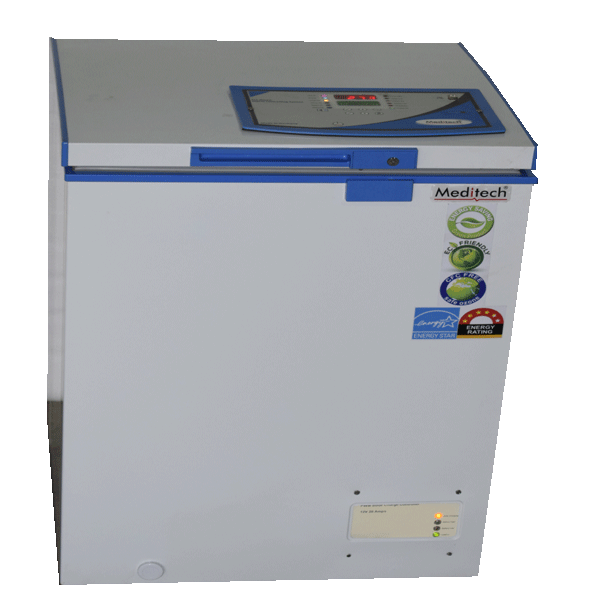
The test tubes that are kept inside a solar powered refrigerator covered with a color-coded plastic cap. They often include additives that mix with the blood when collected (see below), and the colour of the tube's plastic cap indicates which additives that tube contains.
The plastic caps are opaque for tubes with a normal vacuum. Translucent-topped tubes contain a weaker vacuum in the same sized tube, and will obtain less blood. The weaker suction makes them more suitable for smaller sized veins, because the standardised suction of the tubes may cause the veins of elderly people or those with delicate veins, to collapse. In this case a syringe should be used instead.
Contents of tubes
A large SST II vacutainer.
The tubes may contain additional substances that preserve the blood for processing in the medical laboratory. Using the wrong tube may therefore make the blood sample unusable.
The substances may include anticoagulants (EDTA, sodium citrate, heparin) or a gel with intermediate density between blood cells and serum. Additionally, some tubes contain substances that preserve certain chemicals or substances within the blood, such as glucose. When the tube is centrifuged, the blood cells sink to the bottom of the tube, are covered by a layer of the gel, and the serum is left on top. The gel enables the tube to be tipped upside-down and transported without the blood cells remixing with the serum. When a tube that contains an anticoagulant is centrifuged, the clear liquid is plasma, which contains the clotting factors.
The meaning of the different colors are standardized across manufacturers.[1][2][3]
The order of draw refers to the sequence in which these tubes should be filled. The needle which pierces the tubes can carry additives from one tube into the next, and so the sequence is standardized so that any cross-contamination of additives will not affect laboratory results.[3]
Containers containing coagulants
Gold or 'Tiger' Red/Black top: Clot activator and gel for serum separation
Red top PLASTIC tubes: Contains a clot activator and is used when serum is needed
Orange or Grey/Yellow 'Tiger' Top: Contain Thrombin, a rapid clot activator, for STAT serum testing
Containers containing anticoagulants
Green - Contains sodium heparin or lithium heparin used for plasma determinations in clinical chemistry (e.g. urea and electrolyte determination).
Light Green or Green/Gray 'Tiger': For plasma determinations.
Purple or lavender - contains EDTA (the potassium salt, or K2EDTA). This is a strong anticoagulant and these tubes are usually used for complete blood counts (CBC) and blood films. Lavender top tubes are generally used when whole blood is needed for analysis. Can also be used for some blood bank procedures such as blood type and screen, but other blood bank procedures, such as crossmatches must be in a pink tube in most facilities.
Grey - These tubes contain fluoride and oxalate. Fluoride prevents enzymes in the blood from working, by preventing the stage called glycolysis so a substrate such as glucose will not be gradually used up during storage. Oxalate is an anticoagulant.
Light blue - Contain a measured amount of citrate. Citrate is a reversible anticoagulant, and these tubes are used for coagulation assays. Because the liquid citrate dilutes the blood, it is important the tube is full so the dilution is properly accounted for.
Dark Blue - Contains sodium heparin, an anticoagulant. Also can contain EDTA as an additive or have no additive. These tubes are used for trace metal analysis.
Pink - Similar to purple tubes (both contain EDTA) these are used for blood banking.
Black - Used for ESR also known as Erythrocyte Sedimentation Rate or "sed rate." Goes to hematology department.
Other
Red (glass)- Contains no additives. Tests for antibodies and drugs often require these.
Light yellow - Contains sodium polyanethol sulfonate (SPS). Used for blood culture specimens or acid-citrate-dextrose (ACD), used for blood bank studies, HLA phenotyping, and parental testing.
Tan (glass or plastic) - Contains either sodium heparin (glass) or K2EDTA (plastic). Used for lead determinations. These tubes are certified to contain no lead. .
History and culture
[icon] This section requires expansion. (June 2009)
History
It was developed in 1947 by Joseph Kleiner,[4] and is currently marketed by Becton, Dickinson and company.[5] The plastic version, known as Vacutainer PLUS, was developed at Becton Dickinson Research Center, RTP, NC in 1991-1993, by co-inventors E. Vogler, D. Montgomery and G. Harper amongst others of the Surface Science Group as US patents 5344611, 5326535, 5320812, 5257633 and 5246666.[6] Vacutainer is now commonly used in phlebotomy and bloodletting process.[7]
Culture
The purple top tube became an issue in the O.J. Simpson murder case when the defense alleged that small droplets of blood found at the crime scene contained the preservative EDTA; had this been true, it would have meant that the droplet might have been taken from the purple top tube used to collect Simpson's blood and planted at the crime scene.[8]
References
Jump up ^ "Specimen Collection Tubes & Containers". Retrieved 2006-02-01.
Jump up ^ "Quick Collection List". Archived from the original on 2005-12-16. Retrieved 2006-02-01.
^ Jump up to: a b "Blood collection: routine venipuncture and specimen handling". Retrieved 2006-02-01.
Jump up ^ Rosenfeld L (2000). "A golden age of clinical chemistry: 1948–1960". Clin Chem 46 (10): 1705–14. PMID 11017957.
Jump up ^ "BD Vacutainer Venous Blood Collection - Tube Guide". Retrieved 2007-05-30.
Jump up ^ "US Patent Office Patent number search".
Jump up ^ Official Phlebotomy Classes website
Jump up ^ "Transcript of 1997 Simpson civil trial". Archived from the original on 2007-01-01. Retrieved 2006-04-05.
External links
Animated Vacutainer Procedure with Order of Draw
Revisions to order of draw
Categories:
Medical equipment
Blood
Navigation menu
Create account
Log in
Article
Talk
Read
Edit
View history
Main page
Contents
Featured content
Current events
Random article
Donate to Wikipedia
Interaction
Help
About Wikipedia
Community portal
Recent changes
Contact page
Tools
Print/export
Languages
Català
Deutsch
Español
Français
日本語
Edit links
This page was last modified on 9 December 2013 at 20:46.
Text is available under the Creative Commons Attribution-ShareAlike License; additional terms may apply. By using this site, you agree to the Terms of Use and Privacy Policy.
Wikipedia® is a registered trademark of the Wikimedia Foundation, Inc., a non-profit organization.
Privacy policy
About Wikipedia
Disclaimers
Contact Wikipedia
Developers
Mobile view
Wikimedia Foundation
Powered by MediaWiki
From Wikipedia, the free encyclopedia
Jump to: navigation, search
A range of Vacutainer tubes containing blood.
A vacutainer blood collection tube is a sterile glass or plastic tube with a closure that is evacuated to create a vacuum inside the tube facilitating the draw of a predetermined volume of liquid. Most commonly used to draw a blood sample directly from the vein, these also are used to collect urine samples. Vacutainer tubes may contain additives designed to stabilize and preserve the specimen prior to analytical testing. Tubes are available with or without a safety-engineered closure, with a variety of labeling options and closure colors as well as a range of draw volumes.
Vacutainer tubes, invented by Joe Kleiner and BD (Becton, Dickinson and Company) in 1949, are manufactured and sold by BD. Vacutainer is a registered trademark of Becton, Dickinson and Company.
Contents
1 Principles
2 Contents of tubes
2.1 Containers containing coagulants
2.2 Containers containing anticoagulants
2.3 Other
3 History and culture
3.1 History
3.2 Culture
4 References
5 External links
Principles
This article needs additional citations for verification. Please help improve this article by adding citations to reliable sources. Unsourced material may be challenged and removed. (June 2009)
Tiger top Vacutainer filled with blood.
The vein is first punctured with the hypodermic needle which is carried in a translucent plastic holder. The needle is double ended, the second shorter needle being shrouded for safety by the holder. When a Vacutainer test tube is pushed down into the holder, its rubber cap is pierced by the second needle and the pressure difference between the blood volume and the vacuum in the tube forces blood through the needle and into the tube. The filled tube is then removed and another can be inserted and filled the same way. It is important to remove the tube before withdrawing the needle, as there may still be some suction left, causing pain upon withdrawal.
The test tubes that are kept inside a solar powered refrigerator covered with a color-coded plastic cap. They often include additives that mix with the blood when collected (see below), and the colour of the tube's plastic cap indicates which additives that tube contains.
The plastic caps are opaque for tubes with a normal vacuum. Translucent-topped tubes contain a weaker vacuum in the same sized tube, and will obtain less blood. The weaker suction makes them more suitable for smaller sized veins, because the standardised suction of the tubes may cause the veins of elderly people or those with delicate veins, to collapse. In this case a syringe should be used instead.
Contents of tubes
A large SST II vacutainer.
The tubes may contain additional substances that preserve the blood for processing in the medical laboratory. Using the wrong tube may therefore make the blood sample unusable.
The substances may include anticoagulants (EDTA, sodium citrate, heparin) or a gel with intermediate density between blood cells and serum. Additionally, some tubes contain substances that preserve certain chemicals or substances within the blood, such as glucose. When the tube is centrifuged, the blood cells sink to the bottom of the tube, are covered by a layer of the gel, and the serum is left on top. The gel enables the tube to be tipped upside-down and transported without the blood cells remixing with the serum. When a tube that contains an anticoagulant is centrifuged, the clear liquid is plasma, which contains the clotting factors.
The meaning of the different colors are standardized across manufacturers.[1][2][3]
The order of draw refers to the sequence in which these tubes should be filled. The needle which pierces the tubes can carry additives from one tube into the next, and so the sequence is standardized so that any cross-contamination of additives will not affect laboratory results.[3]
Containers containing coagulants
Gold or 'Tiger' Red/Black top: Clot activator and gel for serum separation
Red top PLASTIC tubes: Contains a clot activator and is used when serum is needed
Orange or Grey/Yellow 'Tiger' Top: Contain Thrombin, a rapid clot activator, for STAT serum testing
Containers containing anticoagulants
Green - Contains sodium heparin or lithium heparin used for plasma determinations in clinical chemistry (e.g. urea and electrolyte determination).
Light Green or Green/Gray 'Tiger': For plasma determinations.
Purple or lavender - contains EDTA (the potassium salt, or K2EDTA). This is a strong anticoagulant and these tubes are usually used for complete blood counts (CBC) and blood films. Lavender top tubes are generally used when whole blood is needed for analysis. Can also be used for some blood bank procedures such as blood type and screen, but other blood bank procedures, such as crossmatches must be in a pink tube in most facilities.
Grey - These tubes contain fluoride and oxalate. Fluoride prevents enzymes in the blood from working, by preventing the stage called glycolysis so a substrate such as glucose will not be gradually used up during storage. Oxalate is an anticoagulant.
Light blue - Contain a measured amount of citrate. Citrate is a reversible anticoagulant, and these tubes are used for coagulation assays. Because the liquid citrate dilutes the blood, it is important the tube is full so the dilution is properly accounted for.
Dark Blue - Contains sodium heparin, an anticoagulant. Also can contain EDTA as an additive or have no additive. These tubes are used for trace metal analysis.
Pink - Similar to purple tubes (both contain EDTA) these are used for blood banking.
Black - Used for ESR also known as Erythrocyte Sedimentation Rate or "sed rate." Goes to hematology department.
Other
Red (glass)- Contains no additives. Tests for antibodies and drugs often require these.
Light yellow - Contains sodium polyanethol sulfonate (SPS). Used for blood culture specimens or acid-citrate-dextrose (ACD), used for blood bank studies, HLA phenotyping, and parental testing.
Tan (glass or plastic) - Contains either sodium heparin (glass) or K2EDTA (plastic). Used for lead determinations. These tubes are certified to contain no lead. .
History and culture
[icon] This section requires expansion. (June 2009)
History
It was developed in 1947 by Joseph Kleiner,[4] and is currently marketed by Becton, Dickinson and company.[5] The plastic version, known as Vacutainer PLUS, was developed at Becton Dickinson Research Center, RTP, NC in 1991-1993, by co-inventors E. Vogler, D. Montgomery and G. Harper amongst others of the Surface Science Group as US patents 5344611, 5326535, 5320812, 5257633 and 5246666.[6] Vacutainer is now commonly used in phlebotomy and bloodletting process.[7]
Culture
The purple top tube became an issue in the O.J. Simpson murder case when the defense alleged that small droplets of blood found at the crime scene contained the preservative EDTA; had this been true, it would have meant that the droplet might have been taken from the purple top tube used to collect Simpson's blood and planted at the crime scene.[8]
References
Jump up ^ "Specimen Collection Tubes & Containers". Retrieved 2006-02-01.
Jump up ^ "Quick Collection List". Archived from the original on 2005-12-16. Retrieved 2006-02-01.
^ Jump up to: a b "Blood collection: routine venipuncture and specimen handling". Retrieved 2006-02-01.
Jump up ^ Rosenfeld L (2000). "A golden age of clinical chemistry: 1948–1960". Clin Chem 46 (10): 1705–14. PMID 11017957.
Jump up ^ "BD Vacutainer Venous Blood Collection - Tube Guide". Retrieved 2007-05-30.
Jump up ^ "US Patent Office Patent number search".
Jump up ^ Official Phlebotomy Classes website
Jump up ^ "Transcript of 1997 Simpson civil trial". Archived from the original on 2007-01-01. Retrieved 2006-04-05.
External links
Animated Vacutainer Procedure with Order of Draw
Revisions to order of draw
Categories:
Medical equipment
Blood
Navigation menu
Create account
Log in
Article
Talk
Read
Edit
View history
Main page
Contents
Featured content
Current events
Random article
Donate to Wikipedia
Interaction
Help
About Wikipedia
Community portal
Recent changes
Contact page
Tools
Print/export
Languages
Català
Deutsch
Español
Français
日本語
Edit links
This page was last modified on 9 December 2013 at 20:46.
Text is available under the Creative Commons Attribution-ShareAlike License; additional terms may apply. By using this site, you agree to the Terms of Use and Privacy Policy.
Wikipedia® is a registered trademark of the Wikimedia Foundation, Inc., a non-profit organization.
Privacy policy
About Wikipedia
Disclaimers
Contact Wikipedia
Developers
Mobile view
Wikimedia Foundation
Powered by MediaWiki

No comments:
Post a Comment